Agente Filmico At Eye
17 April, 14:30–17:00 Eye Collection Centre, Amsterdam
17 April, 14:30–17:00
Eye Collection Centre, Amsterdam
On 17 April, I will be presenting Agente Fílmico MAFI at the Eye Collection Centre in Amsterdam (Eye’s black building), as part of the Moving Image, Curation, Presentation and Exhibition seminar series. The session runs from 14:30 to 17:00, and I’d like to invite you — whether you work in archives, exhibitions, digital heritage, film or are simply curious — to join us.
What Is Agente Fílmico?
Agente Fílmico is an open-source conversational interface for exploring audiovisual archives. At its core, it uses large language models (LLMs) and retrieval augmented generation (RAG) to curate short films from independent collections in response to natural-language prompts. You ask questions about a place, a mood, a social event, and the system responds with films, framing them with commentary and context. Not a search bar. Not a catalogue. A conversation.
The current version — Agente Fílmico MAFI v1.5 — is built around the archive of the MAFI collective (Mapa Fílmico de un País), a Chilean documentary collective I co-founded in 2010. It works with 100 short documentaries annotated through a hybrid process of AI and human curation, drawn from a broader archive of over 360 micro-length films. As I mentioned earlier, the code of this interface is open source and available on GitHub for anyone interested in adapting it for their own collection. During the event, I will also demo it.
The MAFI collection
MAFI was established in 2010 by Antonio Luco, Christopher Murray, Ignacio Rojas, and myself with a straightforward yet ambitious idea: to create a comprehensive audiovisual map of Chile. Over the years, more than 60 filmmakers, producers, editors, sound designers, and audiovisual professionals have joined the project — each bringing their own perspective to the textures of everyday life across the country. Not through grand narratives or official accounts, but through a shared format inspired by the observational purity of early cinema — the Lumière views, photojournalism — and embracing the short, modular language of digital video, leading to a simple but distinctive style, marked by a fixed frame, brief duration, and clean sound.
From the Atacama Desert to Chiloé. From quiet domestic moments to the eruption of the 2019 Estallido Social — the nationwide uprising that began as a protest against a metro fare increase and became a reckoning with inequality, identity, and the future of Chilean democracy. Two failed constitutional processes followed. MAFI’s archive runs through all of it.
After sixteen years, MAFI will conclude its operations in 2026. The question of how that archive lives on — who can access it, and in what form — is a big part of what brought us to build Agente Fílmico in the first place.
LLMs, Memory, and the Responsibility of Mediation
There is a harder question underlying this project, and, since I have the space to do it in this post, I want to take a moment to address it rather than leave it implied.
When a language model mediates access to a film archive, it isn’t neutral. Andrew Hoskins argues that generative AI produces a “conversational past”: history dialogically constructed in real time, shaped as much by the model’s tendencies as by what is actually in the archive. LLMs, he writes, produce “a past that was never actually remembered in the first place” — untethering historical material from the human judgements and contexts that gave it meaning. Schuh (2024) goes further, pointing to how large AI models have become “memory agents” — primary mediators of cultural and historical data, now positioned by tech giants at the centre of how we encounter the past. The ethical stakes around historical truth, representativeness, and accountability are real.
Smit, Smits, and Merrill (2024) sharpen this with the concept of stochastic remembering: AI chatbots, trained on hegemonic data, render a probabilistic past shaped by dominant patterns in the training corpus rather than by the specificity of what is in front of them. Humans and AI systems, as they put it, “prompt each other to remember” — which means the user’s own language and assumptions are as formative as the archive itself. Matei (2024) frames this as a shift from history as “media representation” to history as “algorithmic performativity” — a transformation that fundamentally reshapes what it means to be responsible for preserving and transmitting historical legacy.
This matters for MAFI because the collective was built on the conviction that images hold social memory — that what gets filmed and preserved is a political act. Handing over the mediation of that archive to a language model is not a neutral decision. But I don’t believe the solution is to step back from it. At the level of community archives, independent collections, and thoughtfully curated bodies of work, there is something genuinely compelling about what these tools make possible — combining curation with storytelling, transforming audiovisual archives into interactive experiences that connect users with digital heritage and a living sense of cultural history. Our hybrid approach, which integrates human curatorial oversight with a mix of AI and human annotations, and involves testing the LLMs parameters and their adherence to the knowledge base provided by the RAG, is a practical effort to manage that potential responsibly. And ultimately, the prototype serves as a testing ground for an artwork that will explore these tensions: what it means to remember collectively when the mediator is a machine.
The plan for 17 April
The session will unfold in two parts. First, I’ll introduce MAFI — its format, its motivations, and the historical moment its archive captures. Then a live demonstration of Agente 1.5, open to discussion and feedback. I’m most interested in the curatorial and qualitative questions: how does the interface feel? What does it open up, and what does it foreclose?
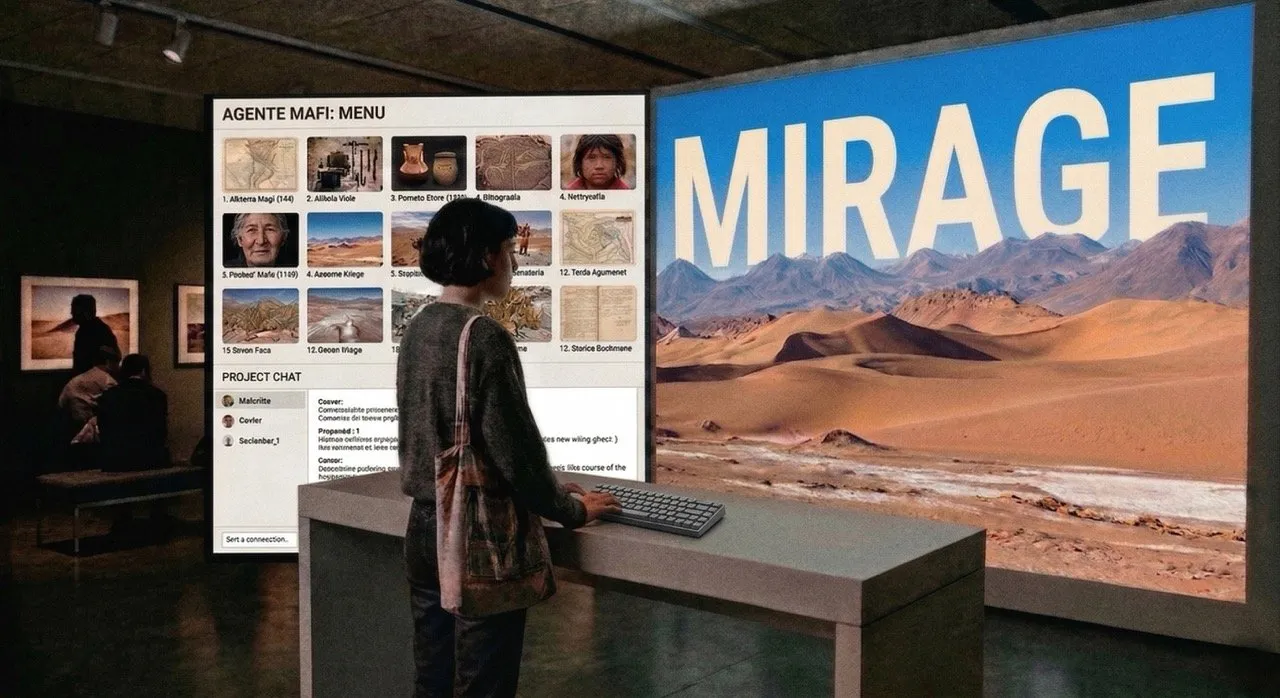
Beyond the prototype, the project is evolving towards a media artwork — working title “Mirage of a Country” — in which the Agente algorithmically edits bespoke short documentaries from user conversations. Where the current version curates and contextualises, this next stage would actively recombine — treating the archive less as a catalogue to be navigated and more as material to be reworked. Not just retrieval, but something closer to a co-authored memory, or mirage, assembled in the moment.
Attend
The session is part of a seminar series coordinated by Floris Paalman. Please to confirm your attendance, get in touch with Floris directly or send me a message.
17 April, 14:30–17:00 / Eye Collection Centre / Asterweg 26, 1031HP Amsterdam
Agente Fílmico MAFI is developed by Pablo Núñez and Antonio Luco (project leads), Ignacio Rojas and David Vandenbogaerde (R&D). Supported by Stimuleringsfonds Creative Industries and the Netherlands Film Academy AI Greenhouse programme.
Suggested Readings
I’d encourage anyone attending to read these two texts beforehand:
-
Trautenberg, E. (2022). A Cinematographic Atlas: Portraits of a Diverse Chile in Mapa Fílmico de un País. Hispanic Studies Review, 6(1). — A clear and inspiring introduction to MAFI and its place within Chilean documentary culture.
-
Ortúzar Madrid, P. (2026). Carnival and Revolt: The Political Ambivalence of the 2019 Chilean Estallido. Bulletin of Latin American Research, 45(1). — A sharp, critical perspective on Chile’s political context from a conservative political scientist. A useful counterpoint to the dominant liberal perspectives among Latin American and continental European scholars.
References
-
Hoskins, A. (2024). AI and memory. Memory, Mind & Media, 3, e18. https://doi.org/10.1017/mem.2024.16
-
Matei, S. (2024). Generative artificial intelligence and collective remembering. Journal of Human-Technology Relations, 2. https://doi.org/10.59490/jhtr.2024.2.7405
-
Schuh, J. (2024). AI as artificial memory. Memory Studies Review. https://doi.org/10.1163/29498902-202400012
-
Smit, R., Smits, T., & Merrill, S. (2024). Stochastic remembering and distributed mnemonic agency. Memory Studies Review, 1(2), 209–230. https://doi.org/10.1163/29498902-202400015
Links